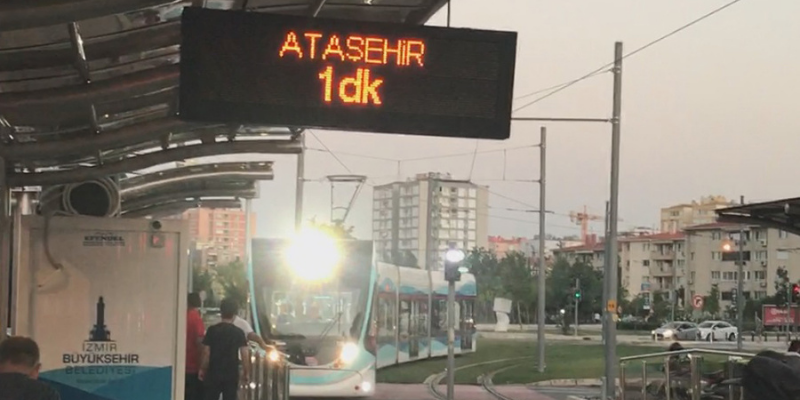
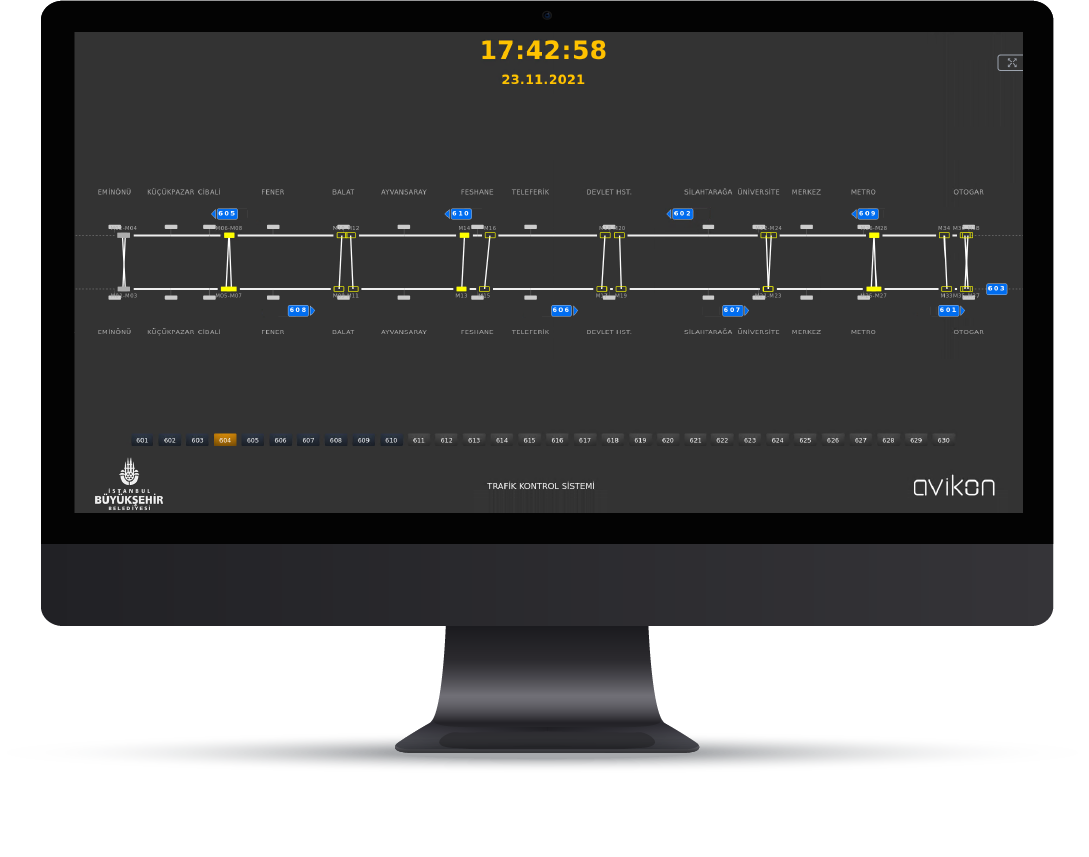
Avikon’s Automatic Vehicle Location (AVL) solution is purpose-built for Bus and Light Rail Transit (LRT), aligned with the demands of modern public transport operators.
With over 200 vehicles and 7 traffic control centers actively using the system, Avikon’s AVL solution has demonstrated its reliability and performance under real-world conditions.
There are two key challenges in AVL systems that must be addressed — and we offer optimized solutions for both.
Advanced Hybrid Localization for Accurate Tram and Bus Tracking
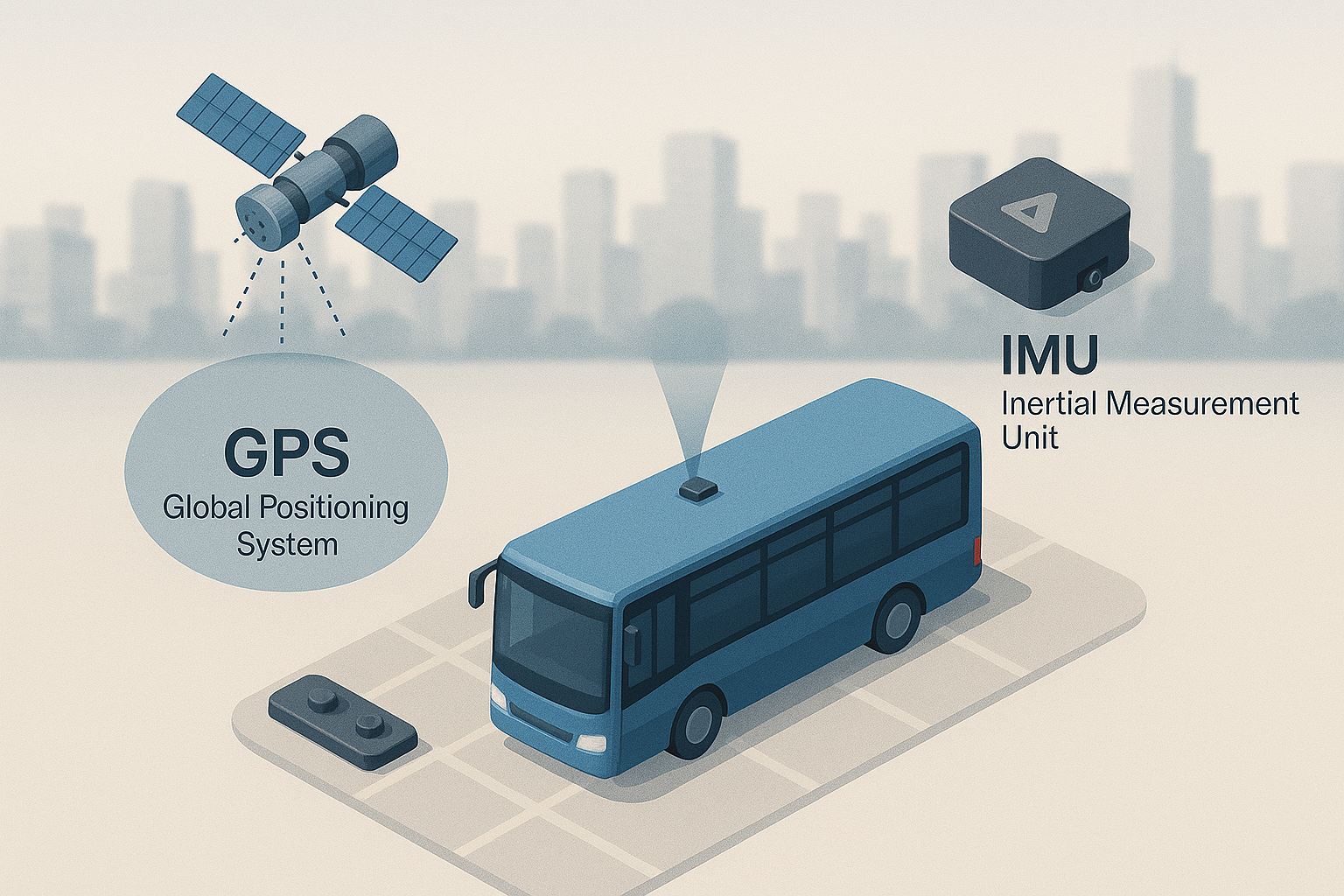
GPS (Global Positioning System) is a generic and widely adopted solution for vehicle positioning. The use of high-precision, automotive-grade GPS chips typically provides sufficient accuracy for AVL systems in open environments.
However, in urban public transport operations such as light rail tramways and buses, signal degradation caused by tunnels, bridges, and high-rise buildings leads to GPS-only solutions becoming unreliable. These urban conditions create blind spots and interference, making it necessary to deploy more advanced localization algorithms.
With over 15 years of experience in positioning and sensor fusion technologies, Avikon offers a robust localization solution that integrates satellite data (GPS), vehicle signals (e.g., J1979, J1939, RPC), and inertial sensors (IMU). This hybrid approach is specifically optimized for urban public transport scenarios.
Thanks to this solution, the vehicle's position can be determined with an accuracy of less than 3 meters, and vehicle speed can be measured with an accuracy of less than 1 m/s — even in GPS-challenged environments.
Reliable Real-Time Connectivity for Urban Public Transport Control Centers
Another key challenge for AVL systems is the reliable transmission of acquired and calculated vehicle data to a central location, such as a traffic control center.
While GSM technologies—particularly LTE (4G)—offer sufficient data transfer speeds, GSM coverage remains a critical bottleneck. Even in urban environments, where population density is high, maintaining a stable data connection can be challenging. To ensure uninterrupted connectivity, the only viable approach is the use of redundant, parallel communication channels that operate simultaneously.
At Avikon, we design and implement network topologies that support multi-channel, multi-technology communication to maximize connection stability. One effective solution is the use of GSM-R technology, as defined by the ERTMS standard, which we deploy in parallel with conventional GSM connectivity.
In operations where GSM-R is unavailable or additional redundancy is required, we utilize dual-channel, multi-operator GSM configurations to ensure continuous communication with the traffic control center.